Coxa antetorsa is a change in the orientation of the femur (thigh bone) that causes the child's knees and feet to turn slightly inward while walking.
Usually, this condition is discovered in childhood and can be observed more clearly between ages 3 and 8, when walking becomes stable.
In most cases, coxa antetorsa corrects itself naturally with growth, but monitoring and early exercises are essential to prevent postural complications and ensure harmonious development.
At Fiziozone, we evaluate and correctly guide children's gait development so that every step is a healthy one.
1. How to recognize coxa antetorsa
🔹 Signs that may raise suspicion:
- The child walks with toes pointed inward (“pigeon toes”);
- The position of the knees is slightly rotated inward;
- Walking instability or rapid fatigue during running may occur;
- The child prefers to sit in a “W” position (with legs twisted laterally behind).
💡 These signs do not always indicate a serious problem, but they deserve an evaluation by a pediatric orthopedic specialist.
2. The importance of periodic check-ups
A regular orthopedic and postural check-up is the safest method to track the development of the hip joints and femur.
🔹 Monitoring recommendations:
- First evaluation: around the age of 1 year, once walking stabilizes;
- Re-evaluations: based on the pediatric orthopedist's recommendation;
- In cases with obvious signs, the doctor may recommend ultrasound, X-ray or gait analysis.
💡 At Fiziozone, we use postural and functional evaluations to observe any deviations early and intervene preventively.
3. Early exercises for correcting coxa antetorsa
Correct movement helps balanced development of the hip muscles and joints.
Simple exercises, performed under the guidance of a kinesiotherapist, can correct the internal rotation tendency and stimulate the natural alignment of the limbs.
🔹 Recommended exercises:
- Exercises to tone the abductor and external rotator muscles of the hip;
- exercises to improve coordination;
- Correcting sitting posture – avoiding the “W” position, encouraging sitting with legs in front.
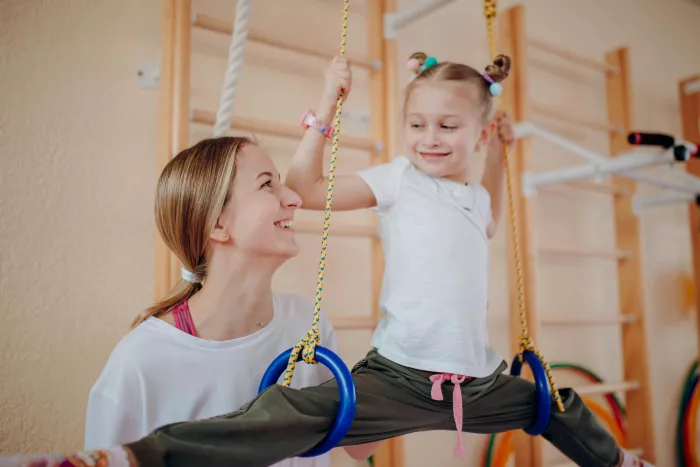
💡 Exercises must be adapted to the child's age and development level. Dynamic games (swimming, dancing, climbing) naturally contribute to correct hip development.
4. When specialized intervention is needed
In moderate or severe cases, coxa antetorsa may require intensive kinesiotherapy or, rarely, orthopedic intervention.
Early intervention significantly increases the chances of complete correction.
🔹 Warning signs:
- The deviation persists after 8–10 years of age;
- The child trips often or complains of hip/knee pain;
- Posture or gait visibly worsens.
💡 With constant medical supervision and correct exercises, most children correct their gait without surgical intervention.
5. Pediatric kinesiotherapy and prevention at Fiziozone
At Fiziozone, we work with children of all ages to prevent and correct developmental deviations through:
- Postural evaluation and gait analysis;
- Personalized pediatric kinesiotherapy;
- Game-based exercises – adapted to the child's age;
- Massage and gentle manual therapy to relax tense muscles;
- Recommendations for correct positioning in daily activities.
💡 With early intervention and regular movement, the child's body develops naturally and symmetrically.
Schedule now!
If you notice that your little one walks inward, has an unstable gait, or prefers to sit in the “W” position, schedule an appointment at Fiziozone for a complete evaluation.
A personalized plan of pediatric kinesiotherapy and corrective exercises will help them develop a harmonious gait and healthy posture.
📞 Call 0773 820 416 or write to us on WhatsApp for a quick appointment.
📍 We are waiting for you at Fiziozone, where prevention begins with the first steps.